For years, we’ve been told the same thing about money:
“Make a budget, track everything, and stick to it.”
Sounds simple, right?
Except… most people don’t.
Not because they’re lazy or bad with money—but because budgeting, the way it’s usually taught, is exhausting. Tracking every coffee, every subscription, every random expense? It quickly turns into a full-time job no one asked for.
And that’s exactly why a growing number of people are quietly giving up on budgeting altogether.
But here’s the weird part:
They’re not going broke.
They’re actually doing better.
The “Anti-Budget” Trend That’s Taking Over
Instead of traditional budgeting, people are switching to something much simpler—what some are calling the “anti-budget” method.
No spreadsheets.
No daily tracking.
No guilt over spending $3 on a snack.
Just a system that runs in the background.
And it’s blowing up because it fits how people actually live.
So… What Are They Doing Instead?
It comes down to one core idea:
Stop controlling every dollar. Control the important ones.
Here’s how it works in real life:
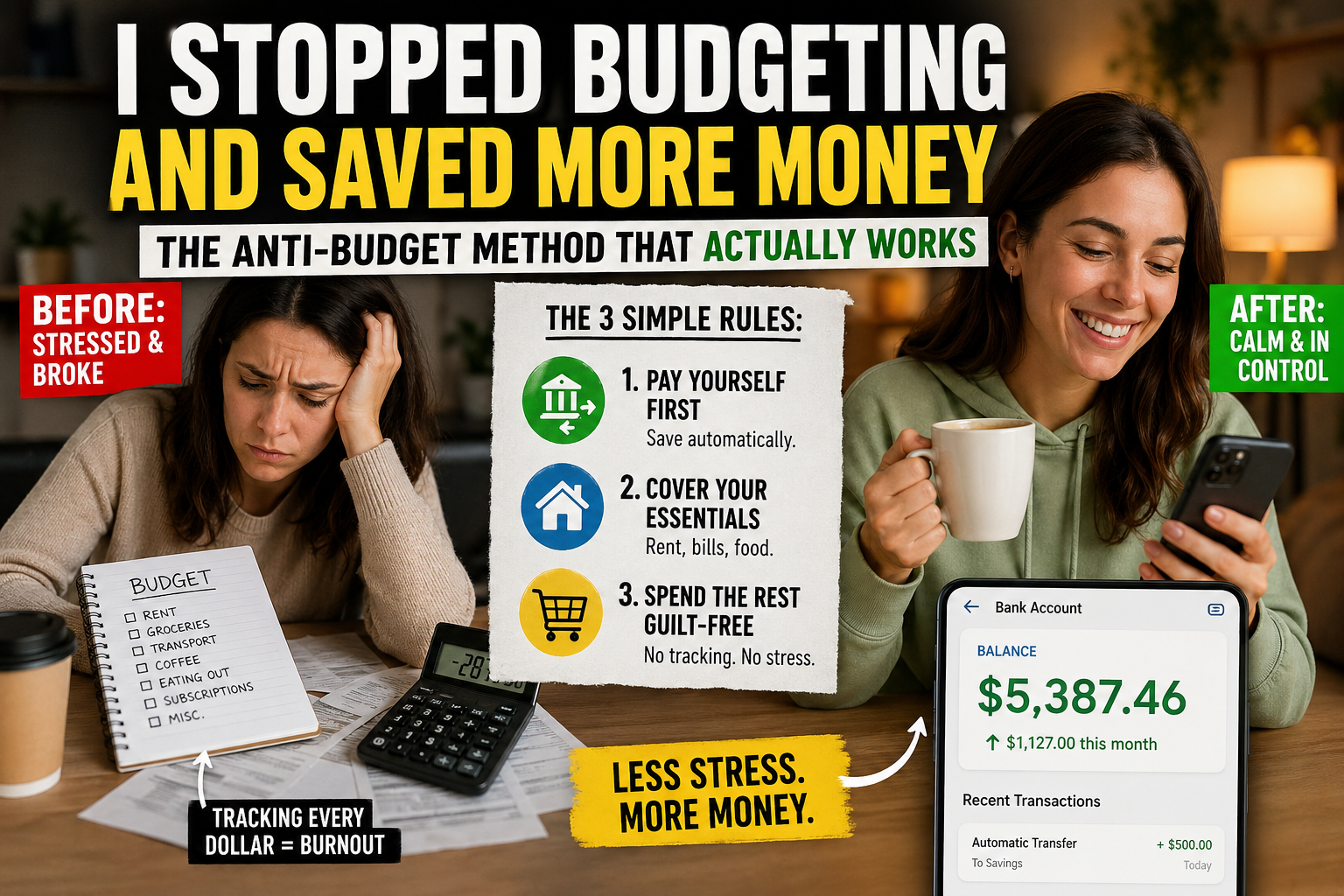
Step 1: Money Is Moved Before You Touch It
As soon as someone gets paid, a chunk of their money is automatically moved—either into savings or investments.
They don’t wait. They don’t decide later. It’s already gone.
So instead of trying to save what’s left… they’re forced to live on what remains.
And surprisingly, that alone solves a huge part of the problem.
Step 2: Essentials Are Covered (Without Overthinking It)
Rent, bills, food—those are non-negotiable.
Instead of tracking every detail, people just make sure those are handled first.
No color-coded categories. No complicated breakdowns.
Just a clear understanding:
“This part is already spoken for.”
Step 3: The Rest Is Fair Game
Here’s the part that shocks most people:
Whatever money is left?
They spend it however they want.
No guilt. No tracking apps. No stress.
If the money runs out, they stop.
If it doesn’t, they’re fine.
That’s it.
Why This Is Working Better Than Traditional Budgeting
It turns out, most people don’t fail at budgeting because they don’t understand money.
They fail because the system relies on constant discipline.
And let’s be real—no one is perfectly disciplined all the time.
The anti-budget approach flips that completely:
- It automates good decisions instead of relying on willpower
- It removes friction, so people actually stick with it
- It eliminates guilt, which is a huge reason people quit
In other words, it works with human behavior instead of against it.
People Are Sharing Their Results
Across social media, more and more people are opening up about trying this method—and sticking to it longer than anything else.
Some say it’s the first time they’ve ever consistently saved money.
Others say they feel less stressed because they’re no longer obsessing over every tiny purchase.
And a lot of them are saying the same thing:
“I finally feel in control… without thinking about money all the time.”
The Catch (Because There Is One)
This method isn’t magic.
If you’re spending way more than you earn, no system will fix that overnight.
And if you never check your accounts at all, things can still spiral.
But for people who just needed something simpler—something realistic—it’s been a game changer.
The One Move That Changes Everything
If there’s one reason this works, it’s this:
Saving happens first. Not last.
That single shift removes the biggest mistake people make—waiting to see what’s left over.
Because most of the time, there is nothing left.
So… Is Budgeting Dead?
Not exactly.
For some people, detailed budgeting still works great.
But for a lot of others?
It was never the right system to begin with.
And now that people are realizing there’s another way—one that doesn’t require constant effort—it’s no surprise it’s catching on fast.
Final Thought
Money management doesn’t need to feel like punishment.
If a system is so complicated you can’t stick to it, it’s not a good system—it’s just a stressful one.
And right now, more people are choosing something simpler.
Something automatic.
Something they don’t quit after a week.
And for once… it’s actually working.