For years, budgeting has been sold as the only way to manage money.
Track every expense. Categorize every dollar. Review it weekly. Stick to it perfectly.
And if you don’t?
You “lack discipline.”
But here’s the truth most people don’t say out loud:
Budgeting doesn’t fail because you’re bad with money.
It fails because it’s built for a version of you that doesn’t exist.
Perfect. Consistent. Always motivated.
Real life isn’t like that.
You get busy. You forget. You overspend one day and think, “I’ve already messed up,” and then stop completely.
So instead of trying to fix your discipline…
What if you just changed the system?
The Shift: From Control to Automation
The biggest mistake people make with money is trying to control everything.
Every purchase. Every category. Every decision.
That’s exhausting.
The smarter approach?
Automate the important decisions… and ignore the rest.
This is what’s known as the “anti-budget” method—and it’s growing fast because it actually fits real life.
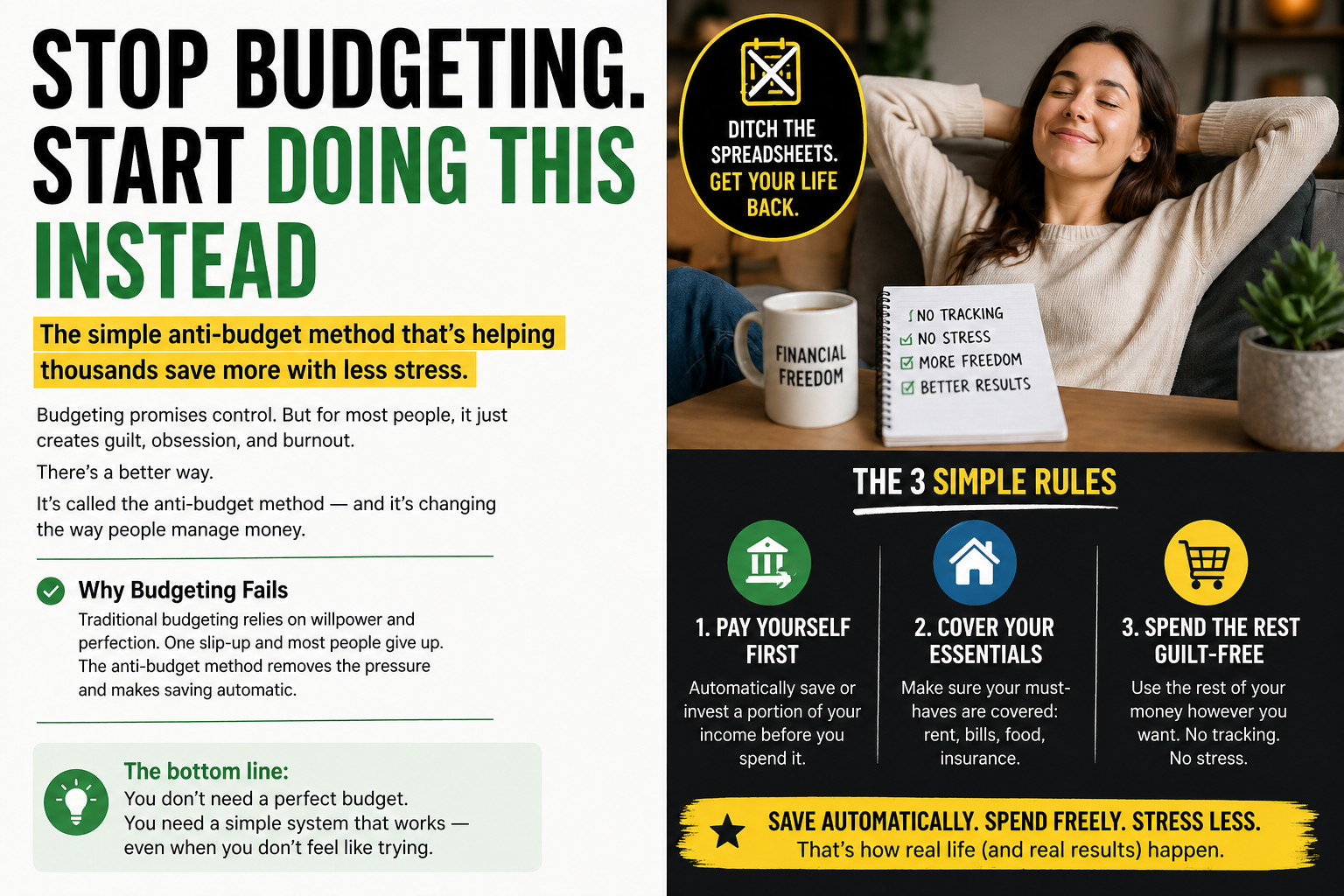
The 3-Step System That Replaces Budgeting
No spreadsheets. No daily tracking. Just three simple rules:
1. Pay Yourself First (Non-Negotiable)
Before you spend anything, a portion of your money is moved automatically.
Savings. Investments. Doesn’t matter—just not spending.
Even 10% is enough to start.
The key is simple:
You can’t spend what you never see.
2. Cover Your Essentials
Your must-haves come next:
- Rent
- Bills
- Food
You don’t need to track every detail. You just need to know these are handled.
No overthinking. No complicated categories.
Just a clear line:
This money is not for spending freely.
3. Spend the Rest Without Guilt
This is where everything changes.
Whatever is left?
You can spend it however you want.
No tracking apps. No feeling bad about small purchases. No stress.
If your balance hits zero, you stop.
If it doesn’t, you’re still within your limits.
That’s your “budget”—without ever calling it one.
Why This Works When Budgeting Doesn’t
Most financial systems rely on willpower.
This one relies on structure.
That difference is everything.
- You don’t need to decide to save → it happens automatically
- You don’t need to track every dollar → limits are built in
- You don’t feel guilty spending → because it’s already accounted for
Instead of fighting your habits, you design around them.
The Hidden Reason People Stick With It
It removes one thing traditional budgeting creates:
Guilt.
When people feel restricted, they rebel.
When they “mess up,” they quit.
But when spending is allowed—within a system—they relax.
And ironically, that’s when they make better decisions.
What This Doesn’t Fix
Let’s be real for a second.
If your expenses are way higher than your income, no method will magically fix that overnight.
And if you completely ignore your finances, things can still go wrong.
This isn’t about doing nothing.
It’s about doing less, but smarter.
The One Move That Changes Everything
If you ignore everything else in this article, do this:
Set up one automatic transfer the moment you get paid.
That’s it.
That single action builds consistency without effort.
And consistency is what actually creates results.
Final Thought
Budgeting isn’t useless.
It’s just not realistic for most people long-term.
If you’ve tried it and failed, maybe the problem isn’t you.
Maybe you’ve been using a system that depends on perfection—when what you really need is something that works on your worst days too.
So stop trying to control every dollar.
Build a system that runs without you.
And let that do the heavy lifting.